Origins
The history of Aikido
Aikido is a budo — a traditional Japanese martial art. Although it proves to be a highly refined art of self-defence, it is also a path of study towards physical and mental refinement, rooted in traditional Japanese culture, in which mind, body and nature are bound together.
This discipline, warlike in origin, became through the will of its founder, Master UESHIBA, the expression of an advanced humanism.
Aikido holds many surprises for the beginner, in fields as varied as martial spirit, sensation, philosophy, aesthetics and culture.
The place of practice — the dojo — is one where Japanese ritual is very much present. Martial training should lead the practitioner, little by little, to a state of harmony and inner peace.
If the concept is philosophical, the practice is very physical indeed, and experienced aikidoka are perfectly capable of defending themselves with great effectiveness.
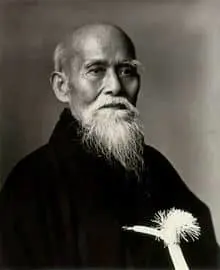
Aikido is not explained; it is practised.
History
Aikido was founded by Morihei Ueshiba.
Born on 14 December 1883, he was of frail constitution, often ill and highly strung. From his earliest years he was strongly drawn to religion. His parents encouraged him to take up physical pursuits such as sumo and swimming, to balance that inclination.
At twenty he went to Tokyo, where he spent his evenings studying the old ju-jitsu techniques, those of the Kito school in particular, under Master Tozawa. At the same time he practised ken-jutsu — the sword — at a Shinkage-ryu dojo.
After falling ill, he resolved to forge himself a new and solid body. He submitted to hard, progressive training built on physical conditioning and raw strength.
Though short in stature (1.54 m), he was far stronger than the average man. But physical strength alone did not satisfy him, and he went to Sakai to study the sword of the Yagyu school under Master Nakai.
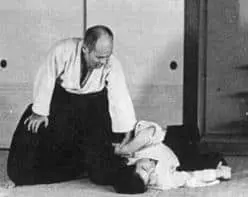
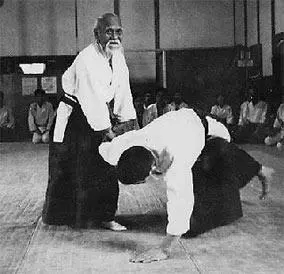
In 1903 Master Ueshiba enlisted in the army. He quickly came first in every kind of exercise, and above all in juken-jutsu, bayonet combat.
In February 1915, while travelling, he met the grand master of the Daito school, Sokaku Takeda, who resolved to teach him the secret techniques of Daito-ryu. On his return he opened a dojo and invited Master Takeda; he built him a house and devoted himself entirely to his care.
In November 1919 he met a great mystic gifted with rare spiritual powers, Wanisaburo Deguchi. For him this meeting was decisive: he was aware that, while he had mastered strength and technique, his spiritual energy remained fragile and faltered at the slightest psychological trial.
Deeply grieved by the death of his father on 2 January 1902, Master Ueshiba spent some months in meditation before deciding to settle in Ayabe, at the Omoto-kyo temple, in order to study under Wanisaburo Deguchi.
Deguchi, a convinced pacifist, left Japan on 13 February 1924 with a few disciples — Master Morihei Ueshiba among them — intending to build a kingdom of Peace in Mongolia, where the Chinese and Japanese armies were then facing each other. They failed in the attempt and were held prisoner by the Chinese armies for several months.
On his return to Japan, Master Ueshiba took up his research into budo and his ascetic life with even greater intensity than before.
It was at this time that he understood that true budo is not to defeat an opponent by force, but to keep them at peace in this world — to accept and to foster the flourishing of every being. Spiritual enquiry is present in all Japanese martial arts, but no one had ever taken it so far as to encompass within it the love of humanity.
From all these encounters and experiences, technical and philosophical alike, Aikido was born in 1925.
By 1926 the name Ueshiba was becoming known, and eminent budoka as well as figures from the political and military world came to visit him.
In April 1931 he settled in Wakamatsu-cho, a district of Tokyo, in a newly built dojo which took the name Kobukan. During the war years Master Ueshiba withdrew to Iwama, 120 kilometres from Tokyo, where the sanctuary of Aikido (Aiki Jinja) stands today.
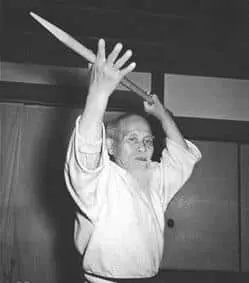
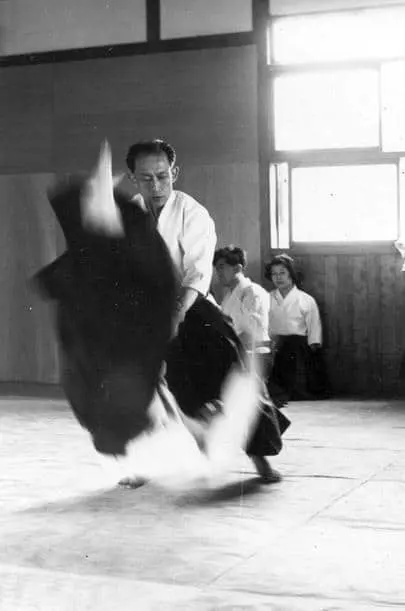
In 1946, the Americans having banned the practice of all martial arts in Japan, the Tokyo dojo was closed until 1948, when it took the name Aikikai. Aikido was the first martial art permitted to resume practice, on account of its pacifist leaning. From then on the number of students only grew, and it was in this period that the modern form of Aikido truly came into being.
Through the 1950s and 1960s Master Ueshiba increasingly left the teaching to his finest disciples, who founded many dojos across Japan or emigrated abroad, and to his son Kisshomaru Ueshiba, who in 1967 became Director General of the Aikikai Foundation.
When the venerable master passed away on 26 April 1969, at the age of 86, Aikido had spread across the world and was practised by hundreds of thousands of people on five continents.
On his father’s death, Kisshomaru Ueshiba — born on 27 June 1921 — became Doshu, the guide of the way, the master of masters, after studying economics.
He died on 4 January 1999 at the age of 77. On his death it was his own son’s turn (the Waka sensei) to become Doshu, in 1999, having been Director General of the Aikikai Hombu Dojo since 1986. Moriteru Ueshiba thus represents the third generation, after his grandfather and his father.
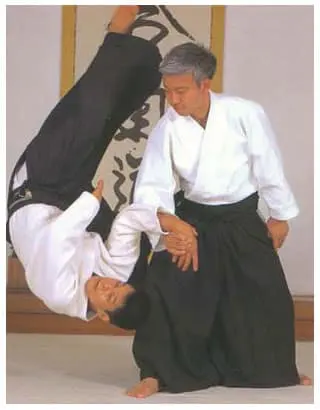
The characters
The budo practised today, for the most part in a peaceful, humanist and artistic form, are methods of educating and refining the individual.
To grasp what sets Aikido apart from the other budo, it is worth explaining literally the meaning of the three characters that make up the word: ai, ki and do.
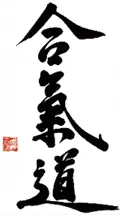
Ai means union, harmony, unification. One may assume that there is, at the outset, a situation of opposition, of conflict between two people who are not in harmony. But it will also be necessary for each to resolve the oppositions and contradictory tensions within themselves. Harmony with oneself allows for a better relation with the other and, conversely, studying harmony with one’s partner allows one to improve oneself.
Ki may be translated as vital energy, breath of life, power. It is a search for harmony that can only be achieved through precise technical knowledge of the movements of Aikido, in order to enter into relation with the other.
Do is the way, the study, the path. A project, a prospect, in the active sense, with the idea of advancing along the right road. In Aikido it is therefore the direction in which to progress and reach a state of harmony.
Aikido bears the mark of a culture, but practice alone allows each of us to feel what it truly holds.
More often than not, words distort the discipline and fail to bring out the notions of suppleness, harmony, wisdom and effectiveness, or the importance of the body–mind relation.
Aikido is not explained; it is practised.